
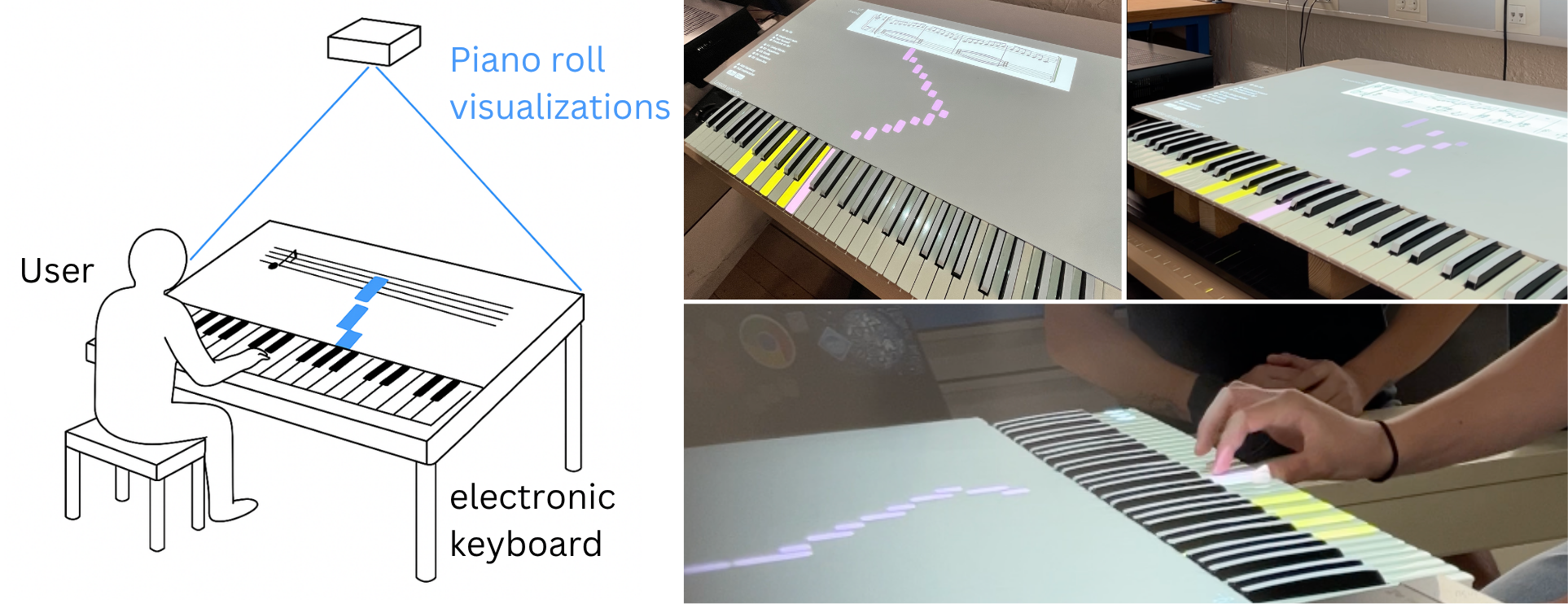
A new HICUP Lab paper, “ImproVisAR: Designing Augmented Reality Piano Roll for Teaching Improvisation,” has been published in Virtual Reality, a Q1-ranked journal from Springer Nature. The paper was authored by Jordan Aiko Deja, Sandi Štor, Ilonka Pucihar, Maheshya Weerasinghe, Rafael Marco Balbin, Klen Čopič Pucihar, and Matjaž Kljun. The paper presents ImproVisAR, an augmented reality piano training system that uses piano roll visualisations to support the teaching and learning of piano improvisation.
The research explores how AR-based visual guidance can help learners develop improvisation skills, a complex and often less-taught area of traditional piano education. The study found that participants using ImproVisAR experienced reduced cognitive load over time, sustained engagement, and higher expert-rated scores in aspects such as rhythm, flow, musicality, and overall musical impression.
Publication:
Deja, J.A., Štor, S., Pucihar, I. et al. ImproVisAR: designing augmented reality piano roll for teaching improvisation. Virtual Reality 29, 140 (2025). https://doi.org/10.1007/s10055-025-01215-z
Abstract:
Improvisation is an important skill in music instrument learning, but remains a less-taught topic in traditional piano education. To improvise effectively, learners must develop musical vocabulary, creative confidence, and comfort in performance. These demands make piano improvisation a complex teaching challenge where technology interventions may offer support. Prior short-term studies on augmented piano roll visualisations have shown promise for teaching sight-reading and motor coordination in novice students. However, how such approaches can support advanced learners in acquisition of improvisational skills remains under-explored. To address this gap, we present ImproVisAR, an interactive piano training system that teaches improvisation through augmented piano roll visualisations. Concepts and tools derived from a co-design process with improvisation experts are integrated as structured learning modes. We validated the system through a four-day controlled study (n=6) comparing an AR-based condition with a traditional sheet music condition following a mixed-methods approach to data analysis. We collected and analysed subjective ratings of cognitive load, creativity support, user-experience, expert evaluation of performances, interaction logs, and qualitative insights collected from daily post-study interviews. Our findings show that participants experienced reduced cognitive load over time, sustained engagement across sessions, and AR participants showed higher expert-rated scores, particularly in rhythm, flow, musicality and overall musical impression. Participants also reported greater immersion, freedom to create musical content and motivation to continue playing. We discuss these findings in relation to user experience and creativity support, and offer design recommendations for AR systems that aim to teach complex, expressive skills such as musical improvisation.
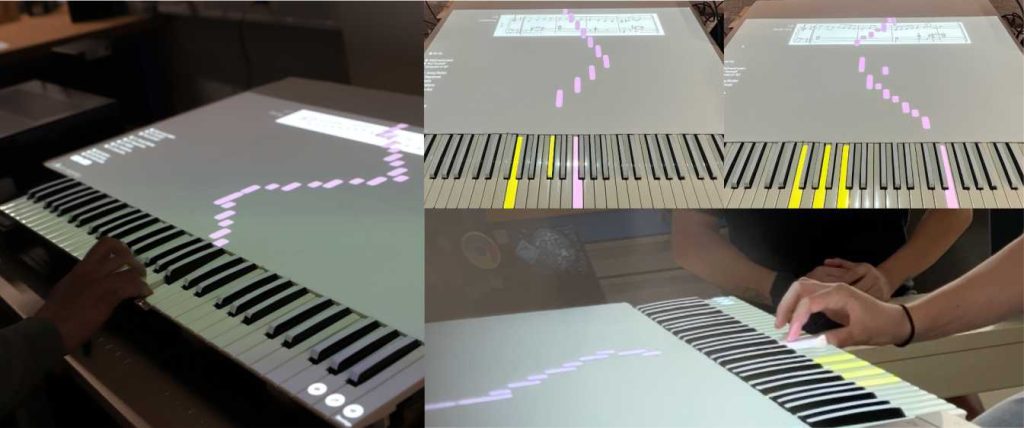
This publication builds on the earlier ARPiano project, featured in our previous project news. Read more here.
Follow HICUP Lab in its official channels for more updates:
X (formerly Twitter)
Website
Youtube
Linkedin
For feedback regarding our media content, you may contact our Social media and web manager.