
A new paper by HICUP Lab researchers, in collaboration with the Department of Information Science of Stellenbosch University, has been published in the International Journal of Human–Computer Interaction (Taylor & Francis).
The paper, titled “Can Immersion Protect us From Distraction? The Impact of Real-World Distractions on Learning in Augmented Reality”, is co-authored by Klen Čopič Pucihar, Karolina Trajkovska, Maheshya Weerasinghe, Ali Waqas, Douglas A. Parry, Daniel B. le Roux, and Matjaž Kljun.
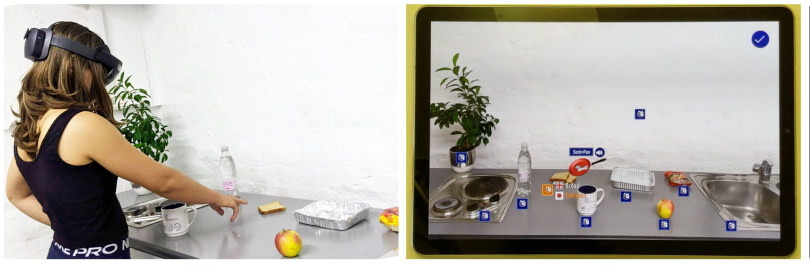
The study tested whether augmented reality can protect learners from everyday distractions such as phone calls, notifications, and office noise during a vocabulary learning task. The research found that AR users felt less distracted and remembered less irrelevant distracting information, but AR did not improve learning performance; in fact, distraction-related performance decline was greater in AR, suggesting that AR annotations alone may not be enough to shield learners from real-world interruptions.
Publication:
Čopič Pucihar, K., Trajkovska, K., Weerasinghe, M., Waqas, A., Parry, D. A., le Roux, D. B., & Kljun, M. (2026). Can Immersion Protect us From Distraction? The Impact of Real-World Distractions on Learning in Augmented Reality. International Journal of Human–Computer Interaction, 1–21. https://doi.org/10.1080/10447318.2026.2633224
Abstract:
While many digital distractions can be managed, real-world interruptions, such as phone calls, notifications, and office noise, are harder to control and can harm productivity, well-being, and learning. Mixed reality systems like Augmented Reality (AR) are often described as immersive—a property which might protect users from such disruptions. We tested this assumption by comparing a head-mounted AR interface that overlays digital annotations on physical objects with a traditional flat screen during vocabulary learning under common office distractions. In a user study (n = 32), AR users reported feeling less distracted and recalled less task-irrelevant information, but their learning performance did not improve. Instead, distraction-related performance decline was greater in AR. Physiological and self-report measures showed no reduction in effort or workload, and participants with higher auditory distractibility did not benefit. Overall, AR annotation alone may not sufficiently shield learners from real-world distractions, motivating new design approaches.
Follow HICUP Lab in its official channels for more updates:
X (formerly Twitter)
Website
Youtube
Linkedin
For feedback regarding our media content, you may contact our Social media and web manager.